Sunday, June 14, 2026

Critters

 I have a soft spot for critters. "Critters", for the uninitiated, are small industrial or light rail switchers/shunters. They are almost always small, and here I mean "tiny", even on standard gauge. As a child I would see them occasionally working small yards around the industrial areas of my hometown of Jacksonville, Florida. Only a few major railroads owned them. Theirs was the domain of the mundane. 

The Christmas I decided to really get into model railroading, 1973, would see me gifted with my first. It's actually a funny story - for my birthday a few weeks prior I had been gifted with a crisp twenty dollar bill, and in 1973 that was a lot of money for a then twelve year old. I was allowed to purchase anything with it I desired. Mom took me to JM Field's, and I beelined straight back to the toy and hobby section. 

And bought a train set. 

It was a confusing affair, a Life-Like H0 train set, with a CP Rail F-unit, a Swift wooden refrigerator car, a gondola (forgot the roadname) and a caboose. As I recall, the caboose was not CP Rail, I think it was Santa Fe. Regardless, this came to $14.99. I had money left over for a trip to the hobby shop for more track!

Mom sort of freaked out.

She had already bought me a set for Christmas. I told her that I planned to have a number of locomotives eventually, and I would still love that set. 

The set she got me was from Tyco, and was a bit more organized than the Life-Like set. It was the "Switcher Freight", with a Tyco "Industrial" switcher, another (though steel this time) Swift  refrigerator car, a Union Pacific gondola, and a proper matching AT&SF caboose. 

Of the two locomotives I got that month, that little Tyco switcher proved the most durable, lasting until at least 1977 when I moved away from trains. 

I recently acquired another one. 


Like so many of the locomotives I acquire, this was misbegotten, dead, a non-runner. It is still missing parts, but these things are a breeze to work on (well, some of the 1970's versions are at any rate). Once I got it running it does so quietly, gliding over the rails gracefully, though you can give the Tyco/Mantua MU2 motor in it full power and it takes off like a race car. 

The thing is, I already have a number of these types of locomotives already, these "could-be" Plymouths. 

Tyco at the top, Mehano and Lima second row, another Mehano at the bottom

Whose was first?

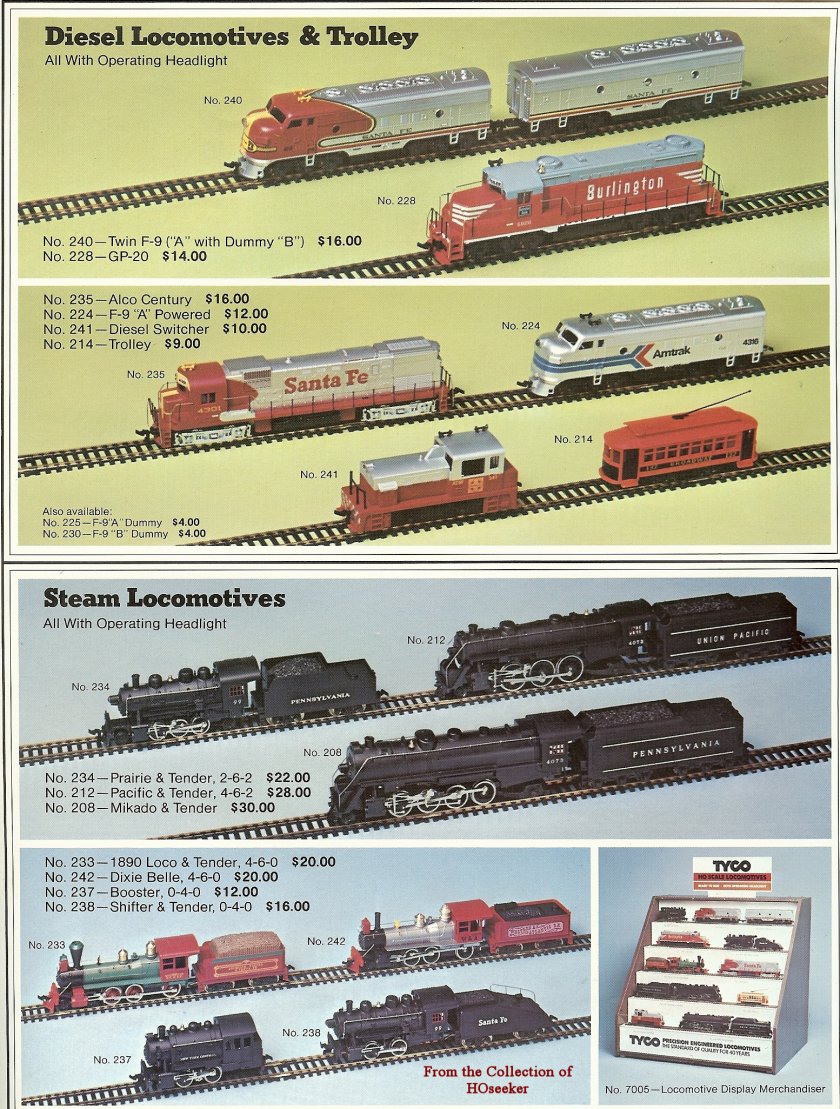
For a long time I thought it was the Tyco version, but recently I discovered that AHM was offering the Mehano version in 1967 (reference this page at HOSeeker). 

So when did Tyco introduce theirs?

Near as I can tell, it popped into their catalog sometime between the 1970 and 1972 catalog (HOSeeker again). Tyco's version replaced their previous "Industrial Switcher" that had been in production since their 1969 catalog. 

Which is sad, actually. 

The previous version, while still using the MU2 power unit, was actually closer to scale, even though the prototype it was based on, the Plymough CR-4, still had to be enlarged to fit the mechanism! The Plymouth MDT, upon which the Mehano, later Tyco, and Lima (released 1975) were based was even smaller. The net result is that model is actually closer to S (in fact, probably larger) than H0. Even as a kid I found the cab to be pretty big for such a small locomotive. When I finally saw a true Plymouth MDT type, it was dwarfed by the fifty foot Railbox boxcar it was shuttling. 

There are plenty of differences between these models. The AHM/Mehano versions only have one axle drive. In fact, the reason for them choosing this design and subsequently enlarging it was because of the mechanism, which was derived from the motor that had originally driven the Rivarossi Fairbanks C-Liner and EMD BL-2. It's a fairly hefty motor. When Tyco produced their version this wasn't a problem, and in fact it's a better puller because both axles are powered (I still have yet to finish the CR-4 locomotive, but I suspect similar performance). 

The Lima version is another matter. While both axles are powered, the model is fairly light. I had to add more weight in order to obtain good performance. The motor is the common "flat" motor that Lima introduced in the late 1950's. 

There's still work to be done until I can call the old Tyco MDT finished, to say nothing about the CR-4 and the three imports. Yet they have a place in my heart. They may be odd and oversized, but you have to admit, they do have an allure. 

Tuesday, June 9, 2026

ALPS, I Did It Again...

 My biggest soft spot where toy and model railways are concerned has to be the mass produced department/five & dime store variety of train sets. The great bulk of these produced between 1945 and, say, 1980, have all been mostly forgotten. Unlike their hobby shop counterparts, most were never meant to last that long. 

The greatest number of these cheap train sets were made in Japan and imported under various names. One of the more interesting brands was ALPS, which was actually Shojo Ltd.. While they made a variety of train sets, the vast majority of which were either 0 or "Japanese S" gauge, they did make one H0 gauge set. Apparently, it is somewhat rare, and for that reason information on it is scarce. 

I actually lucked into a locomotive from this mysterious set. 


When I first saw it I suspected that it might be the elusive H0 model, but that design has been used over and over again. It's based on a fairly common Japanese 2-6-2 Prairie locomotive, the C58 class, though here it has been reduced to 0-6-2. I decided to chance it, and it paid off. 

It was the mysterious model. 

Mine arrived missing the pins that held the side rods in place, so I improvised with 2-56 machine screws. Scale-wise, while the model is H0 gauge, it is probably closer to 1/76 or 1/80, what is today called H0j. 

Amazingly, it ran immediately, though it was  rather loud. Motor bearings needed lubrication. 

These toy locomotives were not meant to last long, so little provision was made to open them up to do things like lubricating the various drive parts. I used a plastic eyedropper to attempt to get oil to the forward motor bearing, though the rear one was visible at the back of the cab. 

The noise dropped somewhat, but it was still loud. 

During a test run, it abruptly stopped. Was the motor dead? Did a wire come loose? There was no electrical smell normally associated with a burnt out motor, no smoke. 

I had to open the model up. 

The shell was simply held in place with two small brass rivets at the rear base of the cab. Using a small metal file I was able to drill them out, and once done the shell was slid back off the chassis, revealing the hidden mechanism. 

With the shell off I decided to examine the drive mechanism. The motor is your typical TKK can found is many 1950's era toys and trains. It uses a pinion and spur to transfer power to a drive shaft in the lower mechanism that powers the first and third axle, which I assume use worm/spur gears. The center axle and wheels essentially float. There is plenty of play, so I assume the track it was sold with used a fairly tight radius. 

As for the motor failure, one of the contacts had become dislocated. One lead is wired, whilst the other simply uses the chassis as a ground. It was simply a matter of moving the motor slightly to reengage. I also added lubricant to the forward bearing and the gears.

To reattach the shell I used two 4-40 x 0.25" machine screws. 

With the locomotive rebuilt, it was now time to test it again, and it ran even better, though it is still rather loud. Nature of the beast, I suppose. 

I have to admit that I have become rather enamored of this weird locomotive. 

Gwynn, however, doesn't share that feeling. 


Friday, June 5, 2026

Well, It's A Start

 My modest layout. 

My previous layout base had to be taken down as it was sagging in spots. This gave me an opportunity to lengthen my layout a little. Since this layout will not be permanent (in fact, henceforth they all must be temporary) I simply decided to use a green fabric over my folding table. 

The yard in the center is based on a Hornby Dublo switching puzzle, and is actually deceptively complicated in operation. The track still needs some cleaning before it will be completely operational. 

Again, it's a start. 

Monday, June 1, 2026

High Rails, Deep Flanges, & Small Scale

Left to right, Bing, Trix (Bakelite), Trix (fiber), Fleischmann, Tri-Ang, Atlas (brass). 


Make no mistake, I love very early H0 and 00 locomotives and rolling stock. 

Years ago when I was considering building a massive H0 scale empire, I acquired a junk Rovex Princess Elizabeth Pacific. Its shell was warped, chassis missing a center driver wheel, and frankly I was unsure what to do with it. It really didn't fit in with the theme I was planning, that being an American Appalachian line with hefty American style locomotives and American style rolling stock. 

Yet the trim little English locomotive had my attention. 

Sadly, I discovered that attempts to run it on my track was for naught. 

The oversized flanges were bottoming out on the molded plastic spikes on my track. 

The model was sadly lost not quite a year later due to various misfortunes that befell me. I would love to have another. 

Anyway, the problem is a duel betwixt accuracy and reliability, as well as nostalgia. 

Accuracy demands rails that are closer to scale. Reliability demands wheels that won't derail. Nostalgia, well, that's another matter. 

The early proponents of scale model railroading started pushing scale standards early in the hobby. This was particularly notable here in the United States. Most early American made H0 and 00 made an attempt to keep wheels closer to scale, within reason. Modelers elsewhere who were concerned with accuracy did pretty much the same. 

Yet the manufacturers, especially European, continued to produce deep flanged equipment. This goes back to the hobby's tinplate roots. 

Bing was the company that brought us the 16.5mm gauge standard for H0 and British 00 (as opposed to "scale" 00, which is a can of worms!). Their initial offerings included stamped metal track, which would later include a center rail for electric models. It is from those humble beginnings that our more common standards emerged.

Bing track had a rail depth of almost 1/10" (2.5mm). If this size seems familiar it's because it is the same as modern code 100 rail, which despite efforts to be pushed aside is still remarkably popular. 

After Bing's bankruptcy, Trix, on both the Continent and in the UK, made Bakelite roadbed track that now used rails that were slightly higher, in fact closer to 1/8" (3.2mm). The next generation Trix track, which switched over to fiber ties, dropped back to what was essentially code 100, albeit still in tinplate. This was the standard that other European and Japanese manufacturers would use for some years, as well as Marx in the United States. 

Rovex went in the other direction. Their initial offerings used deep track yet again, 1/8". This would be carried over to Tri-Ang and would persist for some time (I have no idea how Hornby fared). 

Finally, with the advent of mass produced brass, and then nickel silver, rail, variously on fiber and plastic tie strips, the age of tinplate in 16.5mm gauge pretty much came to an end. The initial standard was again code 100, but other rails sizes were already being offered, such as code 83 (0.083" or about 2mm) and even lower. 

The craftsmen side of the hobby had been using lower rails for a few years since the 1940's. The difference was hand laying versus mass produced. 

Still code 100 still remains the most common. 

Yet if code 100 hasn't really changed since the inception of the hobby with the Bing track, why do "toy" locomotives bottom out?

It's not the rails, it's the ties, specifically the spikes. 

Tinplate rail is fastened to the tie strips with metal tabs. Sometimes these jut from the bottom of the rail, occasionally they are separate pieces, but either way, they are much lower than spike heads. The clearance is tight, to be sure, and frequently the rolling stock has problems with turnouts (points) and diamonds (level junctions or flat crossings). But the lack of perturbances is why deep flanges can ride on this rail even though it is still roughly the same height as code 100 (and how Rovex/Tri-Ang got around it by making their rail taller yet still featuring spikes to hold the rail down).  

Since I have decided to change course on how I want to do my hobby, I have chosen to use Trix track, both the Bakelite and fiber variety, to allow me to run my older equipment in unmodified form. 

And I wish I still had that Rovex Princess Elizabeth, warped shell and all.

Saturday, May 16, 2026

A Box Of Docksiders


 In Louis Hertz's classic "Riding the Tinplate Rails" he mentions something of a poll that was taken to determine what model and toy train enthusiasts wanted. This was the late 1930s, at a time when tinplate was dominated here in the United States by 0 gauge. Scale model railroading, however, was becoming dominated by H0. 

One of the replies amongst tinplaters was a need for smaller scale ready to run equipment that was reasonably priced. 

Naturally, over in Europe you had several companies who were meeting that demand. 

Stateside?

Not so much. 

The two smaller scale locomotives that were ready to run that had been introduced by American companies were both Hudsons - the Lionel 00 scale model, a masterpiece, and the less expensive H0 Gilbert model. 

In 1939, the Gilbert Hudson sold for $12.50. In 2026 dollars that is whopping $297. It was as much as a small 0-27 train set. 

Even then, what they really wanted were smaller locomotives, 0-4-0 and 2-4-0 types. They did exist, but they weren't quite ready to run, and for folks who weren't mechanically inclined that was a problem. Most of the kits at that time required tools like taps and the ability to set rivets and solder. 

It was Varney that answered the call, though it was still a kit. 

In 1941 they introduced their "Lil' Joe" dockside switcher. 

It was not too expensive, and was easy to build. If you chose to detail it with more realistic valve gear, sure, there was a kit for that. But most of them remained relatively simple, and more importantly they were fairly reliable if built properly. 

It is little wonder that when the Italian company Rivarossi decided to enter the American market that one of their first locomotives was a Docksider, a read to run model. This model remained in production into the early 1950s, when it was replaced by a better proportioned version. 

I have no idea if the tinplate enthusiasts of the late 1930s and early 1940s were ever satisfied by the later offerings. Gilbert and American Flyer introduced S gauge tinplate in the immediate postwar period, so there came around a smaller tinplate scale, though the equipment was still about the size of 0-27 equipment (Marx and American Flyer made 3/16" sized models before the war, and while they didn't admit as much, some of the smaller rolling stock that Lionel produced after the war, namely the boxcars, were that size as well). European and Japanese companies would step in eventually, with more ready to run offerings arriving from American companies by the 1950s. 

Anyway, I just spent an hour testing out my collection of Varney, LifeLike, and Rivarossi Docksiders on my temporary Trix Bakelite layout, and they all ran very well, aside from some dirty sections. While the two heavy Varney diecast models (1941 and 1948 vintage) ambled down the right of way with dutiful intent, the lighter LifeLike versions and the Rivarossi ran a little lighter and faster, though they seemed to have no problems whatsoever, coasting over the remaining dirty spots with ease. 

They still need work. Couplers are needed, some damaged sections repaired. But they run. For now, that'll suffice. 

A Surprising Sausage Powered Locomotive

I ordered this model in early April from the UK. Every time they popped up here in the States they would be bought up before I had a chance to place to nab one. On the international market, though, they seemed fairly commonplace. 

I took a chance and bought a "dead". 

It took three weeks to arrive. 

But here it is, a Jouef (for Playcraft) model 431 0-4-0T, sitting on some century old Bing 00 tin track - 


It is actually based on a US Army 0-6-0T that was made to help restore European railways, and they proved to be quite popular. 

So did the model. In addition to being sold as an electric model, it was also sold as clockwork. 

This one is a very early electric version. The motor had actually popped out. The engineers at Jouef designed an ingenious method of installing motor where there was very little or no wiring to deal with, and everything snapped into place. This pinion/crown gear motor had just popped out of place. It took all of five minutes to repair. 


It was running in no time. 

But what about the "sausage"?

The motor, a Jouef design, is known as the M40, and is nicknamed "the Sausage". 

I admit I love this locomotive. The pinion/crown gear transmission and the hefty motor means that it coasts with ease. It glides over any glitchy track with ease. It might not be the most powerful, but it is really reliable. 

I'm pleased with it. 

Wednesday, April 15, 2026

And Then There Were Three... Rails


Left to right - Nomura, Tri-Ang, Trix (fiber ties), Trix (Bakelite base)

I know that it has been some time since I last posted. There has been a lot going on in my life that has kept me even more distracted than usual. While I have still poked around with the trains, I haven't quite been up to sharing it. As I move along, I will likely get to posting some more of my projects. 

It is important for me, though, to mention that my plans have changed. 

I cannot have a permanent layout. The cats, as well as the ever looming possibility of having to relocate (due to health) make that an impractical notion. And honestly?

I tinker. 

One layout fixes your plans. You cannot, on a whim, decide that the spur you stuck in there needs to be relocated, or that you'd like to try an crossover/figure eight design. 

I am also fascinated by how the different H0/00 manufacturers worked out their designs. 

Previously I wrote about my interest in the tinplate style track made by Nomura, Fleischmann, and others, and how I thought it was good for what I do. It has deep rails, upon which large flanges can operate smoothly. Scale flanges operate fine on them as well, so for someone like me who would prefer to keep his vintage equipment in original (or close) condition, it makes more sense. 

I had played around with Tri-Ang Series 3 track, and found that it worked well enough, though it looks to me more like a larger scale narrow gauge track. 

This is where Trix comes in.

My interest in Trix goes back years, to at least 1979 when my high school library got a copy of Allen Levy's classic "A Century Of Model Trains". I saw how Bing created the first "00" scale (and H0 gauge) trains back in the 1920s, and how Trix came about from that incursion. 

Unfortunately, Trix in any form aside from MiniTrix N scale was rare where I am from. There was Märklin, with its three rail (well, two rail with "nubs") system. There was also the other European and Asian companies. There was even Tri-Ang and Hornby. 

But no Trix. 

After finally landing some Trix pieces, I finally had a chance to see what this system was like. 

The locomotive needed work, but a friend supplied me with another, plus some track. 

And the track has unlocked a realm of possibilities. 

In profile, the rails are similar to the tinplate rails of Fleischmann and its clones (Nomura, Marx, et al). It is deep, so it is forgiving of large flanges (indeed, my Distler American switchers seem to think little of it). The outer rails are insulated from one another. This allows two locomotives to operate on the same track with different controls, using the center rail as a common. 

With a proper setup, one can run both two rail and three rail locomotives. 

There are problems with current, though. 

Most classic Trix runs on AC. After 1957 or therabouts they began a switch to DC, and later in the 1970's Trix Twin switched to two rail. 

With proper switches, and being forever mindful of what one is doing, it is possible to use both currents. 

I have setup a couple of simple circle tracks so far and am rather impressed with the build of the equipment. There is still so much to learn here, but this might be the best solution for me. 

Friday, February 27, 2026

NewOne "Teakettle" With An Italian Heart

 This actually happened a couple of weeks back, finally getting around to writing about it. The NewOne B&O "Teakettle" 0-4-0T has been remotored, but not with an original. I received a box of motors, and one in particular, a Rivarossi vertical motor, I suspect from their original Indiana Harbor Belt 0-8-0.

The brass mounting strip, which is soldered to the end bell of the motor, was almost a perfect fit, needing just a screw hole refiled and the whole strip itself slightly reshaped. Another concern was the worm gear pitch, but it works well enough, if a bit loud (contrast that to the NewOne Camelback, whose motor assembly purrs). 

The shell had to be slightly reworked, as the motor sits slightly more forward than the original rectangular NewOne motor. To accomplish this, I ground down a portion of the interior just at the joint between the cab and boiler. For now, this is being left open, as it really isn't too obvious. Also, I filed off the rest of the broken pilot and replaced it with a diecast one that was almost the right size, though I had to adjust it a couple of times, as it was shorting out. 

While it is still a bit loud, it runs, and rather well at that. Next, we need to do some painting and couplers, and this model should be ready to go.