I have a soft spot for critters. "Critters", for the uninitiated, are small industrial or light rail switchers/shunters. They are almost always small, and here I mean "tiny", even on standard gauge. As a child I would see them occasionally working small yards around the industrial areas of my hometown of Jacksonville, Florida. Only a few major railroads owned them. Theirs was the domain of the mundane.
The Christmas I decided to really get into model railroading, 1973, would see me gifted with my first. It's actually a funny story - for my birthday a few weeks prior I had been gifted with a crisp twenty dollar bill, and in 1973 that was a lot of money for a then twelve year old. I was allowed to purchase anything with it I desired. Mom took me to JM Field's, and I beelined straight back to the toy and hobby section.
And bought a train set.
It was a confusing affair, a Life-Like H0 train set, with a CP Rail F-unit, a Swift wooden refrigerator car, a gondola (forgot the roadname) and a caboose. As I recall, the caboose was not CP Rail, I think it was Santa Fe. Regardless, this came to $14.99. I had money left over for a trip to the hobby shop for more track!
Mom sort of freaked out.
She had already bought me a set for Christmas. I told her that I planned to have a number of locomotives eventually, and I would still love that set.
The set she got me was from Tyco, and was a bit more organized than the Life-Like set. It was the "Switcher Freight", with a Tyco "Industrial" switcher, another (though steel this time) Swift refrigerator car, a Union Pacific gondola, and a proper matching AT&SF caboose.
Of the two locomotives I got that month, that little Tyco switcher proved the most durable, lasting until at least 1977 when I moved away from trains.
I recently acquired another one.

Like so many of the locomotives I acquire, this was misbegotten, dead, a non-runner. It is still missing parts, but these things are a breeze to work on (well, some of the 1970's versions are at any rate). Once I got it running it does so quietly, gliding over the rails gracefully, though you can give the Tyco/Mantua MU2 motor in it full power and it takes off like a race car.
The thing is, I already have a number of these types of locomotives already, these "could-be" Plymouths.
 |
| Tyco at the top, Mehano and Lima second row, another Mehano at the bottom |
For a long time I thought it was the Tyco version, but recently I discovered that AHM was offering the Mehano version in 1967 (reference this page at HOSeeker).
So when did Tyco introduce theirs?
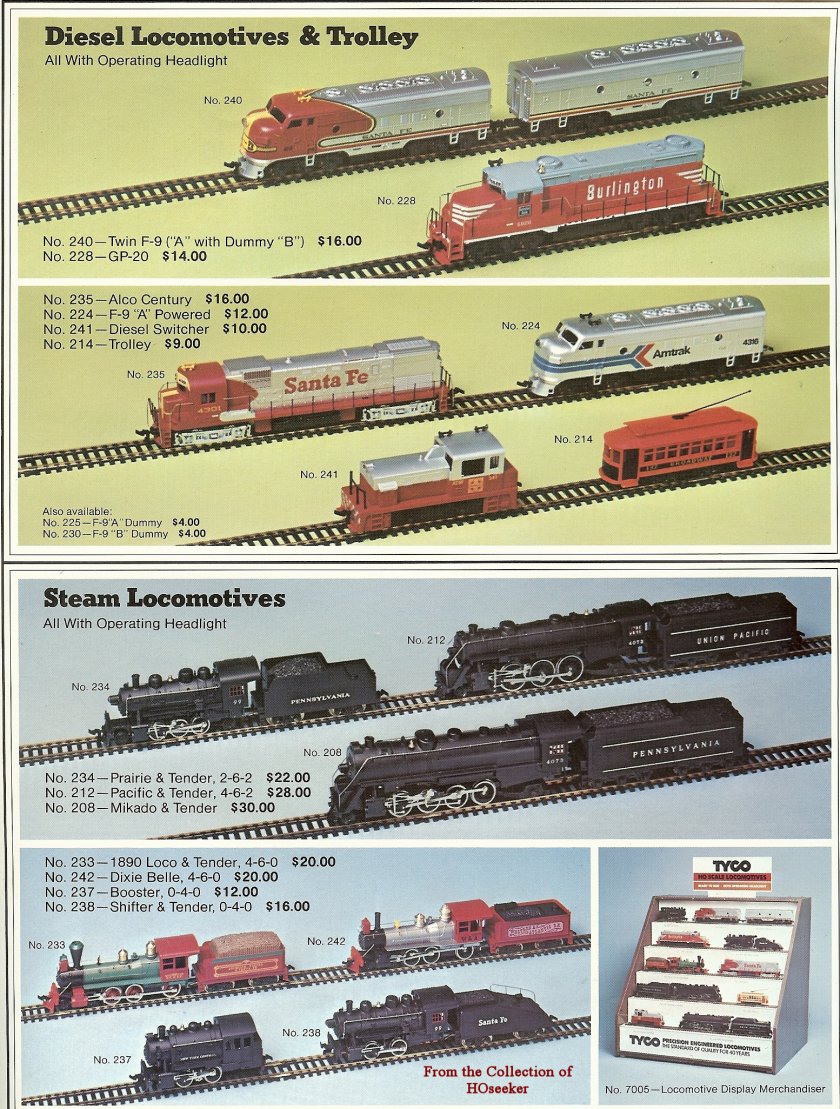
Near as I can tell, it popped into their catalog sometime between the 1970 and 1972 catalog (HOSeeker again). Tyco's version replaced their previous "Industrial Switcher" that had been in production since their 1969 catalog.
Which is sad, actually.

The previous version, while still using the MU2 power unit, was actually closer to scale, even though the prototype it was based on, the Plymough CR-4, still had to be enlarged to fit the mechanism! The Plymouth MDT, upon which the Mehano, later Tyco, and Lima (released 1975) were based was even smaller. The net result is that model is actually closer to S (in fact, probably larger) than H0. Even as a kid I found the cab to be pretty big for such a small locomotive. When I finally saw a true Plymouth MDT type, it was dwarfed by the fifty foot Railbox boxcar it was shuttling.
There are plenty of differences between these models. The AHM/Mehano versions only have one axle drive. In fact, the reason for them choosing this design and subsequently enlarging it was because of the mechanism, which was derived from the motor that had originally driven the Rivarossi Fairbanks C-Liner and EMD BL-2. It's a fairly hefty motor. When Tyco produced their version this wasn't a problem, and in fact it's a better puller because both axles are powered (I still have yet to finish the CR-4 locomotive, but I suspect similar performance).
The Lima version is another matter. While both axles are powered, the model is fairly light. I had to add more weight in order to obtain good performance. The motor is the common "flat" motor that Lima introduced in the late 1950's.
There's still work to be done until I can call the old Tyco MDT finished, to say nothing about the CR-4 and the three imports. Yet they have a place in my heart. They may be odd and oversized, but you have to admit, they do have an allure.

No comments:
Post a Comment